Products / Coconut Ingredients
Organic • Kosher options • Non-GMO
Coconut Ingredients
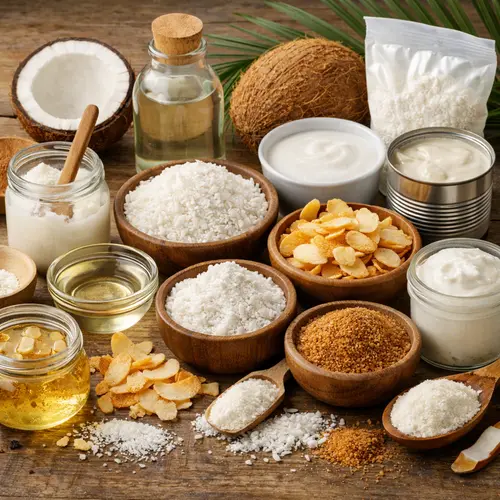
Wholesale supply for coconut ingredients with organic options, documentation support, and custom processing formats for USA & Canada buyers. Coconut ingredients are used for texture, sweetness, dairy-free creaminess, and clean-label fat systems across bakery, bars, confectionery, beverages, and savory formulations. We support dry coconut cuts (flakes/shreds/fine), powders (flour, milk powder, cream powder), liquids (milk/cream), and fats (coconut oil and MCT) depending on your application.
Texture
from shreds and flakes
Creamy
dairy-free systems
Sweet
coconut sugar options
Functional
oils, powders, blends
On this page
Jump to item list, format guidance, quality docs, packaging, and the quote form.
Typical items in this category
This category covers common coconut-based ingredients used across food manufacturing. Availability, origin, and formats vary—request pricing for current options. If you’re matching an existing ingredient, share your spec sheet (cut size, fat %, sweetness, moisture, packaging) to reduce trial time.
| Ingredient | Common formats | Typical use cases | Notes |
|---|---|---|---|
| Aminos | Liquid seasoning (program dependent) | Savory sauces, marinades, seasoning systems | Share sodium targets and flavor profile needs |
| Butter | Solid fat (temperature-dependent), blocks/pails (as applicable) | Bakery fats, confectionery, dairy-free formulations | Often spec’d by melting profile and handling method |
| Chips (flavored) | Flavored coconut chips (as applicable) | Snack inclusions, toppings, trail mixes | Ask about chip size, sweetness, and flavor variants |
| Cream | Liquid coconut cream (as applicable) | Sauces, soups, beverages, dairy-free bases | Share fat % target and viscosity expectations |
| Cream Powder | Powder (granulation dependent) | Dry mixes, beverage powders, instant systems | Ask about dispersibility and flavor intensity |
| Flakes | Wide flakes, medium flakes (as applicable) | Bakery toppings, inclusions, snack blends | Specify flake size and breakage tolerance |
| Flour | Fine powder (granulation dependent) | Gluten-free baking blends, fiber positioning | Ask about fat content and moisture limits |
| Fine Coconut | Fine/desiccated cuts (as applicable) | Uniform blends, bakery, bars | Used when you need consistent distribution and lower visual impact |
| Coconut Milk | Liquid coconut milk (as applicable) | Beverages, sauces, soups, dairy-free bases | Share fat % and stabilization expectations |
| Coconut Milk Powder | Powder (instant/dispersible programs as applicable) | Dry beverage mixes, RTM powders, instant foods | Ask about dispersibility, caking control, and flavor |
| Coconut Oil & MCT Oil | Liquid/solid fats depending on temperature; drums/pails (as applicable) | Functional fat systems, beverages, bars, confectionery | Specify odor/flavor neutrality and handling temperature range |
| Shredded Coconut | Long shreds, medium shreds (as applicable) | Bakery, bars, toppings, inclusions | Specify strand length and desired chew |
| Coconut Smiles | Curved pieces (as applicable) | Snacks, mix-ins, garnish | Ask about sweetness and moisture/chew profile |
| Coconut Sugar | Granulated, fine granules (as applicable) | Baking, confectionery, sweetening systems | Specify color and granulation for consistent blending |
| Sweetened Coconut | Sweetened shreds/flakes (as applicable) | Bakery inclusions, toppings, confectionery | Share sweetness target and labeling constraints |
| Toasted Coconut | Toasted shreds/flakes (as applicable) | Bakery, granola, inclusions, toppings | Toast level affects flavor, color, and breakage |
Note: Coconut formats are often specified by cut size (flake/shred/fine), moisture and fat content, sweetness (for sweetened chips/sugar), and toast profile (for toasted items). Powders are often specified by dispersibility and caking behavior.
Multiple formats, one ingredient family
Coconut can function as a texture inclusion, sweetener, dairy-free creamy base, or fat system—depending on the format you choose.
- Shreds/flakes for chew and visual texture
- Powders for instant mixes and blends
- Oils for functional fat systems
Process-ready options
We help you align coconut format to your line: dosing, mixing, storage, and finished-product targets—especially where dusting, caking, or breakage matters.
- Cut size matched to inclusion distribution
- Powder dispersibility targets
- Toast profiles aligned to flavor and color
Documentation support
Manufacturer-focused support for common QA documents (availability varies): COA, specs, allergen statements, and claim documentation where applicable.
- Lot-level COA (where offered)
- Specs aligned to your QA needs
- Traceability by lot and origin
Formats & specification considerations
Coconut ingredients behave differently depending on cut size, fat content, and processing. Below are common specification levers buyers use to ensure consistency in production.
Shredded, flakes, and fine/desiccated coconut
Dry coconut cuts are popular in bakery, bars, granola, and toppings. Cut size drives bite, distribution, and line performance.
- Cut size: long shreds vs flakes vs fine for blend uniformity
- Breakage/fines: impacts dusting and visual appearance
- Moisture targets: supports shelf stability and flow
- Fat content: impacts mouthfeel and flavor release
- Color/appearance: important for garnish and toppings
Tip: If you’re seeing segregation in blends, consider a finer coconut cut or align particle sizes across the mix.
Sweetened and toasted coconut
Sweetening and toasting add flavor and can change texture and fragility. These formats are commonly used in bakery and granola.
- Sweetness level: impacts label, taste, and browning
- Toast profile: light vs medium vs darker notes
- Color targets: important for visual consistency
- Breakage tolerance: toasted product can be more fragile
- Application fit: toppings vs inclusions may need different cuts
Tip: If you’re baking after adding toasted coconut, consider a lighter toast to avoid over-browning.
Coconut flour
Coconut flour is used in gluten-free baking, fiber positioning, and specialty blends. Flour performance is driven by granulation and hydration.
- Granulation: affects mouthfeel and blending
- Hydration/absorption: can be high—impacts dough/batter viscosity
- Fat content: affects flavor and shelf behavior
- Color: consistency matters for light baked goods
- Application fit: often used as a partial replacement in blends
Tip: If you’re reformulating, request guidance on inclusion rate to maintain texture and avoid dryness.
Coconut milk, cream, and powders
Coconut milk/cream and their powders are used in dairy-free beverages, soups, sauces, and dry mixes. Buyers often specify fat %, dispersibility, and flavor neutrality (or desired coconut character).
- Fat % target: impacts richness and mouthfeel
- Powder dispersibility: important for instant drink mixes
- Caking control: powder handling and shelf stability
- Flavor profile: neutral vs pronounced coconut note
- Stabilization expectations: important in ready-to-drink bases
Tip: If you’re using powders, share your mixing method (shaker vs industrial) and target viscosity for better alignment.
Coconut oil and MCT oil
Coconut oil and MCT oil are used as functional fat systems. Specs often focus on odor, taste neutrality, and handling conditions (since coconut oil can change physical state with temperature).
- Odor/taste: neutral vs light coconut character
- Handling temperature: impacts whether product is liquid or solid
- Packaging: pails/drums and receiving needs
- Application fit: bars, beverages, confectionery, functional blends
- Documentation: COA/specs and program certificates where applicable
Tip: For winter shipping or cooler warehouses, confirm how you plan to warm or liquefy product if needed.
Coconut sugar and snack formats
Coconut sugar and snack cuts (chips/smiles) are often specified by granulation, moisture/chew, and sweetness.
- Granulation: affects blending and dissolution
- Color: batch consistency is important for finished-product appearance
- Moisture/chew: impacts shelf life for snack inclusions
- Flavor: caramel-like notes vary by program
- Application: toppings vs inclusions may drive cut selection
Tip: If you’re using coconut sugar in dry blends, match particle size to other sweeteners to reduce segregation.
How buyers use coconut ingredients
Coconut ingredients support multiple product categories. Buyers often select coconut format based on whether the goal is texture (shreds/flakes), creamy dairy-free base (milk/cream/powders), or functional fats (coconut oil/MCT).
Bakery
- Shreds/flakes for toppings and inclusions
- Sweetened/toasted for flavor and color
- Coconut flour in gluten-free blends
Bars & snacks
- Toasted coconut for crunch and aroma
- Fine coconut for uniform distribution
- MCT/coconut oil in functional builds
Beverages & mixes
- Milk/cream powders for dairy-free bases
- MCT oil for functional positioning
- Powder dispersibility and caking control
Sauces & savory
- Coconut milk/cream for curry and soup bases
- Aminos for savory seasoning systems
- Oil systems for mouthfeel and fat delivery
Choosing the right coconut cut: practical comparison
Selecting the right coconut format is often about balancing appearance, texture, and blend performance. Here’s a quick guide to help align a coconut cut to your application.
| Format | Texture & appearance | Best for | Spec focus | Operational notes |
|---|---|---|---|---|
| Long shreds | Chewy, visible strands | Bakery inclusions, bars, toppings | Strand length, breakage/fines, moisture | May tangle in some feeders; verify dosing method |
| Flakes | Wider pieces, high visual impact | Premium toppings, granola clusters | Flake size, color, breakage | Fragility increases if toasted |
| Fine/desiccated | Small cut, uniform blend behavior | Dry mixes, bakery, bars | Particle size distribution, fines, moisture | Lower segregation risk in mixed systems |
| Toasted coconut | Crunchier, stronger aroma | Granola, bakery toppings, snack mixes | Toast level, color, breakage tolerance | Can darken further during baking |
| Milk/cream powder | Powdered, creamy base when reconstituted | Beverage mixes, soups, sauces | Dispersibility, caking control, fat % | Moisture sensitive; protect from humidity |
| Coconut oil / MCT | Fat system (liquid/solid by temperature) | Functional products, confectionery, beverages | Odor neutrality, packaging, handling temps | Temperature management may be required |
If you’re matching an existing product, include your current cut specification and photos (when possible) to speed up alignment.
Quality, food safety & documentation
Manufacturers typically require consistent documentation for onboarding and receiving release. Documentation availability depends on the supply program, but we can often support standard files requested by QA teams.
Common documents (as available)
- Certificate of Analysis (COA) by lot
- Specification sheets
- Allergen statements
- Non-GMO statements (program-dependent)
- Organic certificates for organic items
- Kosher certificates for certified items
Common QA focus areas
- Moisture and flowability (dry coconut and powders)
- Cut size distribution and fines (shreds/flakes)
- Toast color profile consistency
- Fat % targets (milk/cream, oils)
- Traceability fields (lot coding, origin)
If you have a vendor onboarding packet, attach it to your inquiry to speed up review.
Storage & handling guidance
- Keep sealed and protected from humidity
- Store cool and dry, away from strong odors
- Use FIFO rotation and record lot codes
- Plan for temperature effects on oils/fats
Packaging & logistics for bulk coconut ingredients
Packaging depends on the coconut format (dry vs liquid vs oil). Dry items commonly ship in food-grade bags; liquids and oils may ship in pails/drums. Share your receiving constraints so we can align the right packaging and delivery plan.
Typical packaging
- Food-grade bags for shreds/flakes/fine coconut and powders
- Pails/drums for oils and liquid products (as applicable)
- Palletized shipments aligned to warehouse handling
Exact pack sizes vary by item—tell us your preferred pack and max pallet height.
Lead time drivers
- Origin and production scheduling
- Certification verification (organic/kosher)
- Custom processing (toasting/cut sizing)
- Lane capacity and appointment scheduling
Receiving checklist
- Delivery hours & appointment policy
- Dock type (standard dock vs ground unload)
- Labeling requirements (lot, PO, item code)
- Storage conditions (humidity control, temperature)
Request a quote for coconut ingredients
Share the details below and we’ll respond with available options for your target volume in the USA or Canada. This form pre-fills into your main contact workflow for faster handling.
Quick quote details
FAQ
Do you offer organic options for Coconut Ingredients?
Many coconut items have organic options. Share the ingredient(s), format (shreds/flakes/powder/oil/liquid), volume, and delivery lane, and we’ll confirm availability by origin and program.
Can you supply bulk packaging?
Yes—bulk and wholesale pack sizes are available depending on the coconut ingredient. Dry items commonly ship in food-grade bags, while oils and some liquid products may ship in pails or drums. Tell us your receiving constraints to align packaging.
Do you support custom processing?
Often yes. Depending on the product, we can support custom cut sizes, toasted profiles, powder granulations, and custom blends for inclusions and toppings.
What’s the difference between desiccated coconut, shredded coconut, and coconut flakes?
They’re related formats but differ mainly by cut size and appearance. Shredded is longer strands, flakes are wider pieces, and fine/desiccated formats are smaller cuts used for uniform blending. Share your application and texture target and we’ll recommend the best fit.
Do you offer sweetened or toasted coconut?
Yes—sweetened and toasted formats are often available depending on the program. Provide your desired sweetness level and toast color/flavor so we can confirm suitable options.
Can you provide documentation for QA onboarding?
Where available, we can provide typical documents such as COA, specification sheets, allergen statements, and applicable certificates (organic/kosher). If you have a vendor onboarding packet, include it with your request.
Ready to source coconut ingredients?
Whether you need shredded coconut for bakery, milk powder for dairy-free mixes, or coconut oil/MCT for functional fat systems, we can help align the right format, documentation, and delivery plan for your production program.
For urgent requests, include ingredient, format, key specs (cut/toast/fat %), volume, destination, and certification needs for the fastest response.