Home / Products / Freeze-Dried Vegetables & Herbs / Spinach
Wholesale ingredient • Documentation support • Custom processing
Spinach
Wholesale supply for Spinach designed for manufacturing—consistent specs, documentation support, and flexible formats such as flakes, granules, and powder (application-dependent) for USA & Canada buyers.
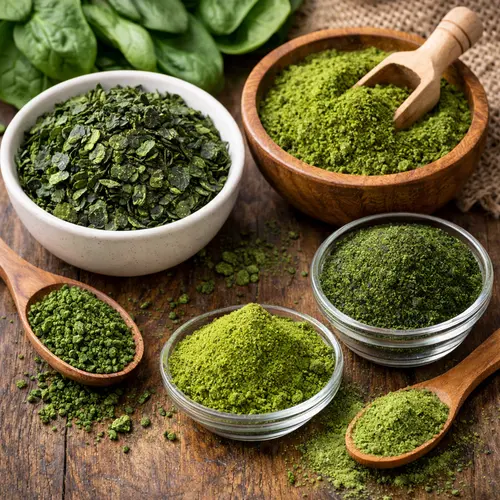
Ingredient overview
Spinach ingredients used in food manufacturing are often supplied as dried formats (including freeze-dried or dehydrated programs depending on the application), enabling longer shelf stability and easy integration into dry blends. Manufacturers use spinach for natural green color, mild vegetable flavor, and nutritional positioning in seasoning mixes, soups, sauces, baked goods, pasta, snacks, and functional blends.
- Common formats: flakes, granules, powder (format depends on program and application)
- Typical appearance: deep green to olive-green; color can vary by processing and crop season
- Typical profile: mild “leafy” vegetable note; stronger in powders and finer cuts
- Key value: clean-label color + flavor contribution in dry systems
If your finished product requires a bright green tone, note your expectation—green intensity can change with heat exposure and storage conditions.
Formats & customization
Choose the format that best matches your product’s texture and mixing behavior. If you need consistent visual pieces, flakes may be preferred; for uniform dispersion, granules and powders are common.
Flakes
- Best for: visible leaf pieces in soups, meal kits, seasoning blends
- Processing benefit: visual appeal with lighter bulk density
- Considerations: can break down with aggressive mixing or high-shear transport
If you want “leafy” identity in the finished product, flakes are a strong option.
Granules
- Best for: even distribution in dry mixes and rubs
- Processing benefit: less dusty than powders; consistent mixing behavior
- Considerations: particle size can influence hydration and color release
Granules are often the middle ground between flakes and powder.
Powder
- Best for: color integration, bakery/pasta systems, beverage/functional blends
- Processing benefit: fast dispersion and uniform color contribution
- Considerations: dust control and flow aids may be relevant for high-speed lines
If your goal is “green color” rather than visible pieces, powder is typically preferred.
Custom processing options (program-dependent)
Need a specific sieve range or dust control approach? Describe your line setup (ribbon blender, tumble blender, high-shear) and we’ll match an option.
Typical specifications (guidance)
Specs vary by format and program. Use the table below as a planning guide and request the current spec sheet for your selected option.
| Parameter | What it impacts |
|---|---|
| Format / cut | Visual appearance (flakes) vs uniformity (granules/powder), blend homogeneity, and finished product texture. |
| Particle size distribution | Mixing behavior, segregation risk, hydration rate, and color release. Often specified by sieve ranges. |
| Moisture | Flowability, clumping risk, and shelf stability. Lower moisture generally supports free-flow in dry blends. |
| Color (visual) | Natural variation can occur. Heat and oxygen exposure can shift green tones over time; packaging and storage matter. |
| Micro targets | QA alignment for your product category (soups, seasonings, snacks). Request current limits based on program and usage. |
| Foreign material controls | Screening and process controls reduce risk. If you have internal requirements, include them in your request. |
| Additives / carriers (if any) | Some powders use processing aids or carriers depending on program. Specify if you need “no carriers” or specific label constraints. |
| Certifications (optional) | Organic / kosher documentation may be available depending on source and lot. |
Applications
Spinach ingredients are used for natural green color, mild flavor, and vegetable positioning. Below are common manufacturing uses and the formats typically chosen.
Soups, broths & meal kits
- Instant soups and cup meals
- Dry broth bases and seasoning sachets
- Meal kit inclusions (visual leaf pieces)
Often used: flakes (visual) or granules (distribution).
Seasonings & snack systems
- Dry rubs and seasoning blends
- Snack coatings and flavor carriers
- Vegetable-forward seasoning profiles
Often used: granules or powder for uniform coverage.
Pasta, bakery & mixes
- Spinach pasta and dough color
- Bakery mixes and savory batters
- Stuffing mixes and fillings
Often used: powder for consistent color and integration.
Choosing the right format (fast guide)
Quality & documentation support
Documentation commonly requested
- COA: lot-linked results for receiving release
- Specification sheet: format definition, key attributes
- Allergen statement: supports labeling and QA programs
- Lot traceability: production planning support (as available)
Documentation availability varies by origin and program.
Manufacturing support
- Spec matching: replace current ingredient with minimal reformulation
- Particle control: select sieve range to reduce segregation
- Dust management: choose granules vs powder based on line needs
- Program fit: align format to your application and hydration behavior
If you have internal QC checks, include them for faster approvals.
Label & claims (general)
- Organic programs may be available (documentation required).
- Carrier-free or “no additives” requirements can be program-specific.
- Color expectations should be aligned to your processing conditions.
For claim-critical products, request the current documentation set before finalizing labels.
Handling & storage (general guidance)
Dried greens are sensitive to moisture pickup and oxygen exposure. Use best practices to maintain flow and color stability.
Storage
- Store in a cool, dry place away from heat and direct sunlight.
- Keep packaging sealed; reseal quickly after opening.
- Use FIFO and track lot codes for traceability.
On the line
- Reduce humidity exposure during batching to limit clumping.
- Powders may benefit from controlled dust collection and gentle feeding.
- Minimize extended high-heat exposure if color retention is critical.
Quality preservation
- Avoid storing near strong odors (greens can pick up aromatics).
- Close containers between weigh-outs to protect color and aroma.
- Follow program-specific storage guidance on documentation.
How to request a quote (fast)
The more detail you share, the easier it is to match the right spinach format and provide accurate pricing/lead-time guidance.
-
Choose the format
Flakes, granules, or powder (and target sieve range if applicable). -
Share your requirements
Organic/kosher needs, moisture/flow expectations, “no carriers” constraints. -
Confirm volume & destination
Annual estimate, order size, and delivery region (USA/Canada).
Quote checklist
- Format: flakes / granules / powder
- Particle target: sieve range or “match current”
- Program: conventional or organic (if required)
- Label constraints: carriers/additives allowed? (Y/N)
- Volume: per order + annual forecast
- Destination: USA/Canada region
- Application: soup, seasoning, pasta, bakery, beverage
- Timeline: target first delivery date
If you have a current spec sheet, paste key requirements to speed approvals.
Example message (copy/paste)
Use this template in your quote form or email:
Ingredient: Spinach (dried format)
Format: flakes / granules / powder
Particle target: ____ (sieve range or “match current”)
Certifications: Organic: Yes/No • Kosher: Yes/No
Label constraints: carriers/additives allowed? Yes/No
Volume: ___ lbs per order • annual forecast ___ lbs
Delivery: USA/Canada • region: ____ • needed by: ____
Application: soup / seasoning / pasta / bakery / beverage
Tip: If you don’t know particle size, share your end use and we’ll recommend a starting format.
Request a quote for Spinach
Share target specs (organic/kosher), format, annual volume estimate, and delivery region (USA/Canada). Include your application so we can recommend the best-fit format.
Request Pricing Request DocumentationIf the form is long, prioritize: Format, Particle, Volume, Destination.
FAQ
Answers below are general guidance. For program-specific details, request current documentation with your quote.
Is this product fresh spinach?
This page is focused on manufacturing ingredient formats commonly supplied as dried spinach (often freeze-dried or dehydrated programs depending on application), such as flakes, granules, or powders. If you need a different format, describe it in your quote request.
How do I choose between flakes, granules, and powder?
Choose flakes for visible pieces, granules for even distribution with lower dust, and powder for color/flavor integration. If you share your process (dry blending, hydration, baking), we can recommend a best-fit format.
Why does spinach color vary?
Color can vary by crop, season, and processing. Heat exposure, oxygen, and moisture can also shift green tones over time. Packaging and storage practices are important for color stability.
Can you support organic programs?
Where available, yes. Include your organic labeling requirement and destination so we can confirm availability and documentation for the program.
Do you ship to the USA and Canada?
Yes. We support USA and Canada buyers and can coordinate documentation needs for your receiving and QA process.