Home / Products / Freeze-Dried Vegetables & Herbs / Onions
Wholesale ingredient • Documentation support • Custom processing
Onions (Freeze-Dried)
Wholesale supply for freeze-dried onions with consistent specs, food safety documentation, and flexible formats for USA & Canada buyers. Freeze-dried formats are commonly selected when you want fast rehydration, strong aroma retention, and ingredient identity in finished products.
Tell us your target cut size, moisture spec (if applicable), and end use (soups, snacks, meal kits, seasoning blends). We’ll match an option optimized for your process.
Why choose freeze-dried onions?
Freeze-drying helps preserve onion aroma and structure while enabling quick rehydration. It’s often used when you want the ingredient to “wake up” rapidly in water-based systems or when you need a premium sensory profile.
Fast rehydration
Freeze-dried pieces typically absorb moisture quickly, helping reduce “hard bits” in instant soups, cup meals, and ready-to-eat kits. This can support more consistent consumer experience and shorter process times.
Aroma & flavor retention
Many buyers choose freeze-dried onions for a strong, fresh-like aroma and clean flavor release—especially in premium seasoning blends, snack seasonings, and meal kits where aroma matters.
Ingredient identity
Slices, flakes, and dices can provide visible onion cues that support “real ingredients” positioning. Choose cut size based on final texture, rehydration time, and visual expectations.
Common applications
Instant soups & cup meals
Fast hydration and recognizable pieces in ramen, bouillon cups, and meal kits.
Snack seasonings
Aroma-forward options for chips, popcorn, crackers, and nut coatings.
Dry mixes & sauces
Dips, dressings, sauce bases, and culinary blends needing clean onion notes.
Common formats
Select the format based on blend uniformity, texture needs, and how quickly the onion should rehydrate. If you have a target spec (particle size, sieve range, moisture), share it and we’ll propose a match.
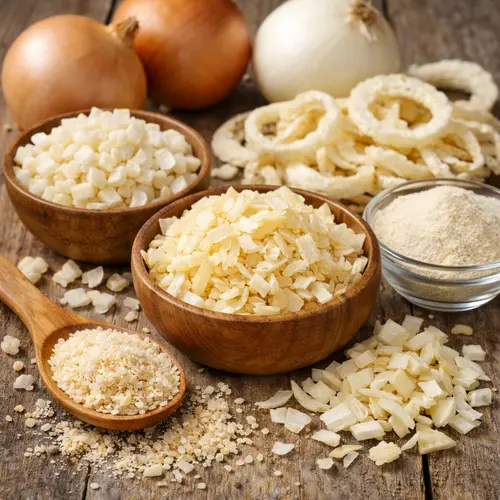
Freeze-dried cuts
- Whole / rings (as available): visual identity for premium kits and culinary packs.
- Sliced / flakes: toppings, meal kits, and “visible ingredient” blends.
- Diced: uniformity for soups and ready meals; predictable portioning.
- Minced: smaller pieces for faster hydration and smoother texture.
Tip: if your process is “add hot water and wait,” smaller cuts often hydrate more consistently. If the process is cook-in, larger cuts can hold identity and texture.
Granules & powder
- Granules: reduce dusting vs. fine powders; stable blend behavior.
- Powder: strong flavor distribution, smooth mouthfeel, fast flavor release.
- Custom mesh targets: align to your equipment and packaging line.
- Anti-caking options: depending on your “clean label” preferences and humidity exposure.
Share your target mesh or the name/spec of your incumbent ingredient and we’ll work to match flow and performance.
Specialty profiles (on request)
Sweet vs. pungent balance
Select a profile aligned to soups, snack seasonings, or savory blends.
Roasted / toasted notes
Add deeper savory character for barbecue, burger, and umami-forward profiles.
Blend-ready sizing
Align onion particle size to salt, sugar, spices, and herbs to reduce segregation.
Specification framework
Actual specifications vary by producer, origin, and format. Below is a practical framework buyers use to align samples, approvals, and ongoing supply. We provide the current spec sheet and COA(s) for the lot(s) being quoted.
Core parameters (typical)
- Appearance: cut uniformity, color range, defect tolerance
- Particle size distribution: target cut size or mesh range
- Moisture: target range based on storage stability and flow needs
- Organoleptic: aroma, flavor intensity, off-notes controls
- Handling: breakage/dusting considerations for delicate pieces
If you have a customer approval template or internal QA form, share it—this is the fastest way to align on the right grade.
Food safety & compliance (as applicable)
- Microbiology: testing aligned to customer requirements
- Allergen statement: cross-contact and facility disclosures
- GMO status: statement where applicable
- Traceability: lot documentation and country of origin details
- Certificates: organic/kosher options by item and processor
If you need documentation for a specific customer, tell us the requirement and destination (USA/Canada).
Performance checklist (help us match your process)
Rehydration target
How quickly should pieces hydrate (e.g., instant cup vs. cook-in)?
Texture expectations
Should onion “disappear” or stay visible with bite?
Blend compatibility
Do you need the onion to match salt/sugar particle sizes to prevent segregation?
Packaging & logistics
Packaging depends on format and program. Freeze-dried pieces may require additional care to minimize breakage during handling and transit. Share your warehouse constraints (pallet height, bag/case preference) and we’ll align options.
Packaging options (typical)
- Bulk cases / lined cartons: common for flakes, slices, and diced pieces
- Bulk bags: for granules/powders where applicable
- Labeling: lot codes, traceability, and receiving-friendly labels
- Palletization: standard configurations based on lane and packaging
Need a specific case label format or pallet spec? Share it in your quote request.
Shipping support
- USA & Canada distribution lanes
- Lead-time planning for production schedules
- Documentation coordination for receiving/QA release
- Support for import/export paperwork when needed
Include destination (city/state/province) and any special delivery requirements (appointment, liftgate, etc.).
Storage & handling notes (general)
Store sealed packaging in a cool, dry environment away from humidity. After opening, reseal promptly to maintain crispness and protect from moisture pickup. If you need formal storage guidance for your QA program, request it with your documentation package.
Application guidance
Choosing the right cut can reduce formulation adjustments and improve consistency across plants. Below are common selection tips.
Instant & rehydration-forward
- Minced/diced hydrate quickly and evenly
- Smaller pieces reduce “hard bits” risk
- Powder can strengthen base flavor in broth systems
If you have a target “ready time” (e.g., 3 minutes), include it in your request.
Seasonings & dry blends
- Granules reduce dusting in production
- Match particle sizes to reduce segregation
- Powder improves flavor uniformity in small-dose blends
Tell us your other major particles (salt, sugar, pepper) and we’ll recommend a compatible onion size.
Meal kits & premium inclusions
- Flakes/slices provide strong visual identity
- Choose sturdier cuts if handling is rough
- Balance piece size with pack size and consumer expectation
For delicate pieces, packaging and transit handling matter—share your packing method and we’ll advise.
Matching an incumbent ingredient
If you’re switching suppliers, standardizing across plants, or moving from dehydrated to freeze-dried, send one of the following to speed alignment:
- Current specification sheet (preferred)
- Cut/mesh target + moisture target + micro requirements
- Notes on current pain points (breakage, dusting, hydration time, flavor variability)
How sourcing & quoting works
We keep sourcing simple and documentation-forward so procurement and QA can move quickly from quote to approval.
Step 1: Share your target specs
- Format (flakes/slices, diced, minced, granules, powder)
- Organic/kosher needs and labeling preferences
- Annual volume estimate and shipment cadence
- Delivery region (USA/Canada) and timeline
The more detail you share upfront, the easier it is to match an option without back-and-forth.
Step 2: Options, docs, and next steps
- We propose available grades aligned to your application
- We share documentation package details (COA/spec/allergen/certs)
- We support sampling when needed
Need side-by-side options (conventional vs. organic)? Tell us and we’ll format the quote accordingly.
Step 3: Production support
Lot planning
Align lots and documentation for receiving, QA release, and scheduling.
Packaging alignment
Coordinate packaging and labeling for your handling and warehouse flow.
Consistency focus
Support consistent particle sizing and predictable hydration behavior.
Related categories
Browse categories where freeze-dried onions are commonly sourced:
Freeze-Dried Vegetables & Herbs Dehydrated Vegetables Spices, Extracts & Flavors
If you don’t see the exact onion cut you need, request a quote with your target specs—cut size, mesh range, and packaging preference.
Request a quote for Onions (Freeze-Dried)
Share target specs (organic/kosher), format, annual volume estimate, and delivery region (USA/Canada). If you have a spec sheet or a mesh/cut target, include it to speed up matching.
What to send
- Format: flakes/slices, diced, minced, granules, or powder
- Target cut/mesh and any hydration performance needs
- Packaging preference (cases/cartons/bags)
- Destination and timeline
- Documentation checklist (COA/spec/allergen/certs)
What you’ll receive
- Available options aligned to your spec and application
- MOQ confirmation and pricing guidance
- Documentation package details
- Support for sampling, lead times, and logistics planning
Note: final specifications and available documentation are confirmed by origin, processor, and lot.