Wholesale ingredient • Documentation support • Custom processing
Mushrooms
Wholesale supply for Mushrooms with consistent specs, food safety documentation, and flexible formats for USA & Canada buyers—ideal for soups, sauces, seasonings, snacks, and ready meals.
Note: Mushrooms vary by species and processing method (freeze-dried vs dehydrated). If you share your end use, we’ll recommend a format optimized for hydration, flavor impact, and processing flow.
Type
Shiitake, porcini, oyster, maitake, blends, etc.
Format
Slices/dice/granules/powder; freeze-dried or dehydrated.
Use case
Soup mix, seasoning, RTM, snack, sauce, plant-based.
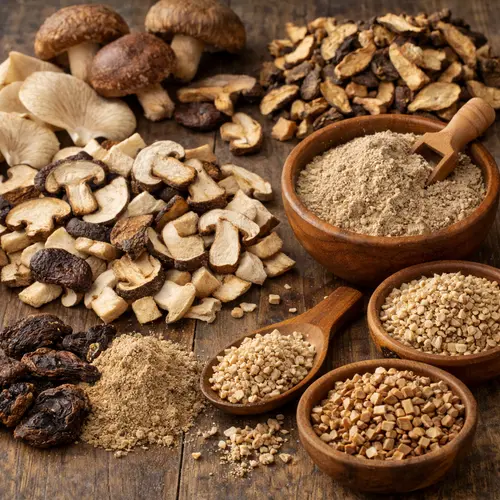
Why manufacturers buy mushrooms
Mushrooms are widely used to deliver savory depth and “umami-forward” flavor, especially in dry mixes and seasoning systems.
- Flavor and aroma lift for soups, sauces, and seasonings
- Texture inclusions for ready meals and blends
- Works well in plant-forward and reduced-sodium flavor strategies (formula dependent)
What we support
Documentation, sourcing support, and format matching for operational teams.
- COA and specification sheet support
- Lot documentation and traceability
- Custom cuts, sieve ranges, and blends (where available)
Best-fit customers
Ideal for teams that need repeatability in flavor and hydration performance.
- Soup and sauce manufacturers
- Seasoning and snack producers
- Brands and co-packers (USA/Canada)
Common mushroom types and programs
Availability varies by origin and processing line. If you don’t see a type listed, request it—programs can change by season and demand.
Shiitake
Popular for robust savory notes in soups, noodles, sauces, and seasoning blends.
Porcini
Often requested for premium aromatic impact in sauces and specialty mixes.
Oyster / Maitake
Used for balanced savory profiles and inclusions, depending on application.
Button / Cremini
Common culinary bases for general-purpose mushroom flavor systems.
Mushroom blends
Blends can balance aroma, flavor strength, and cost targets.
Functional varieties (program-dependent)
Some customers request specific species for supplement-style blends; share your target for current availability.
If you need a specific species for labeling, include the exact name you want shown on the ingredient statement.
Common formats
Mushroom formats are typically selected based on hydration behavior, visual inclusion needs, and dosing/dispersion requirements. Share your application and we’ll propose an option.
- Whole / large pieces (visual inclusions; ready meals; some soup kits)
- Sliced (reconstitutes well; soups, sauces, meal kits)
- Diced (uniform distribution; inclusions; stuffing mixes)
- Granules (seasonings, dry blends, ramen/instant noodles; controlled dispersion)
- Powder (seasoning systems, soups, sauces, rubs; fast incorporation)
- Custom sieve ranges (powders/granules tuned for flow, dust control, and mixing)
Need a specific cut size, sieve range, or moisture spec? Tell us what you’re making and we’ll match an option.
Options & documentation
- Label needs: ask for organic and kosher options (where available)
- QA package support: COA, specification sheet, allergen statement, origin details (program dependent)
- Traceability: lot documentation for production planning and audits
- Import/export support: paperwork guidance for USA/Canada buyers when needed
Documentation availability can vary by origin and format—request current details with your quote.
Freeze-dried vs dehydrated (how to choose)
Both formats are widely used. The best choice depends on hydration expectations, finished-product texture, and cost/processing priorities.
Freeze-dried (often selected for)
- Fast rehydration in hot water applications
- Lighter structure and strong visual inclusion (format dependent)
- Dry mixes where quick “bloom” is important
Dehydrated (often selected for)
- Seasonings, soups, and sauces with longer cook times
- Granules/powders for controlled flavor addition
- Programs where cost targets and robust handling are priorities
If you have a reconstitution time target (e.g., instant cup, 3–5 minutes), include it in the quote request.
Processing notes (what affects performance)
Mushroom ingredients are often chosen based on flavor impact and rehydration behavior. Key technical considerations include:
- Particle size: impacts dispersion, dusting, and perceived intensity in seasoning systems.
- Hydration rate: affects texture in soups/ready meals; format matters.
- Aroma retention: can vary by species and processing—define your sensory target.
- Color contribution: powders can darken blends and sauces; specify if appearance is critical.
- Flow & caking: moisture targets and packaging influence shelf stability in powders.
Tell us whether you need “flavor-only” (powder/granules) or “texture + flavor” (slices/dice) and your hydration environment (hot water, simmer, bake, extrusion) so we can recommend a best-fit format.
Typical specification checkpoints
These are common checkpoints procurement and QA teams request. Exact targets depend on species and format (freeze-dried vs dehydrated). Request the current specification sheet for the option you’re quoting.
| Ingredient identity | Mushrooms (species/program dependent). Include species for labeling when required. |
|---|---|
| Processing type | Freeze-dried and/or dehydrated (availability varies by program). |
| Form / cut | Whole, slices, dice, granules, powder; custom sizing may be available. |
| Particle size / sieve | Defined by mesh/sieve for powders & granules; cut size for slices and dice. |
| Moisture / water activity | Defined per format to support shelf stability and flow; targets depend on your packaging and application. |
| Sensory | Aroma, flavor intensity, and color; alignment helps repeatability across production runs. |
| Micro / food safety | Micro targets and test cadence documented on COA; requirements vary by customer and use case. |
| Allergen statement | Allergen statement support available; cross-contact controls depend on facility and program. |
| Packaging | Bulk packaging with lot labeling and traceability support (program dependent). |
| Shelf life & storage | Provided by format; storage guidance typically includes cool, dry conditions and sealed packaging. |
For seasoning systems, include your dusting tolerance and preferred particle size to reduce line issues.
Common applications
Mushrooms are used for savory depth, aroma, and texture inclusions across many categories.
Soups & broths
Slices/dice for texture; powders for base flavor lift and aroma.
Seasonings & rubs
Granules/powders for controlled umami impact in blends.
Sauces & gravies
Powders for fast incorporation; granules for layered flavor release.
Ready meals
Slices/dice as inclusions in rice dishes, pasta, meal kits, and fillings.
Snacks
Seasoning blends for chips/puffs; some formats used in savory snack mixes.
Plant-forward formulations
Used to build savory character and complexity; formula dependent.
How to request the right option
The fastest path to an accurate quote is a complete spec request. Use this checklist.
Choose species / program
Shiitake, porcini, oyster, blends, etc. (list exact names for labeling).
Select processing type
Freeze-dried vs dehydrated based on hydration time and texture needs.
Define cut / sieve targets
Slices/dice size or mesh range for granules/powder.
Confirm label claims
Organic? Kosher? Any additional label requirements.
Share volume + cadence
Annual volume estimate and shipment cadence help continuity planning.
List QA documentation needs
COA, spec sheet, allergen statement, origin details, etc.
If you’re developing a seasoning, include your target serving size (grams per serving) so we can align intensity expectations.
Packaging, logistics, and supply planning
Wholesale programs are designed for repeat orders and production planning. Packaging and lead time vary by format and origin, so we’ll confirm availability during quoting.
Packaging
Bulk packaging with lot labeling and traceability support. Ask about palletization and receiving constraints.
Lead time
Depends on species, format, inventory position, and any custom granulation steps.
Continuity
Share forecasts to support continuity planning and reduce variability across production runs.
For high-volume seasonings, specify your packaging line (auger filler, VFFS, ribbon blender) so we can align particle size and flow.
Related categories
Browse categories where this ingredient is commonly sourced:
Freeze-Dried Vegetables & Herbs Organic Freeze-Dried Fruit Spices & Seasonings
FAQ
Quick answers for procurement, QA, and product development teams.
MOQs depend on mushroom type, format (freeze-dried vs dehydrated), and any custom processing needs. Share your target specs and annual volume and we’ll reply with options.
Yes. Where available, we can quote organic and conventional programs so you can compare cost, labeling, and continuity.
Programs vary, but common requests include shiitake, porcini, oyster, maitake, and blends. Share your target type(s) and format for current availability.
Custom cuts, sieve ranges, and blends may be available depending on volume and lead time. Provide particle size targets and application details so we can confirm feasibility.
Common documentation includes COA, specification sheet, allergen statement, and country of origin details. Documentation availability varies by origin, facility, and format.
Send mushroom type(s), processing type (freeze-dried/dehydrated), target cut or mesh range, label claims (organic/kosher), estimated annual volume, and ship-to region (USA/Canada). If you have a spec sheet, attach it.
Have a specific requirement (rehydration time, aroma strength, color impact, micro limits, or packaging constraints)? Add it to your request.
Request a quote for Mushrooms
Share target specs (organic/kosher), mushroom type(s), processing type (freeze-dried/dehydrated), format (slices/dice/granules/powder), annual volume estimate, and delivery region (USA/Canada). If you’re replacing an existing ingredient, include your current spec sheet.
Best details to include
- Species/type: shiitake, porcini, oyster, blend, etc.
- Processing: freeze-dried or dehydrated
- Format: slices / dice / granules / powder
- Size: cut dimensions or mesh/sieve range
- Label claims: organic / kosher
- Annual volume + shipment cadence
- QA docs: COA, spec, allergen, origin
Helpful extras (optional)
- Target rehydration time and temperature
- Desired aroma/flavor intensity (baseline vs premium)
- Dusting tolerance and flow needs (for powders)
- Packaging constraints / receiving requirements
- Commercialization timeline
If you want a mushroom blend proposal, list your target profile (earthy, roasted, aromatic) and any budget boundaries.