Wholesale ingredient • Documentation support • Custom processing
Custom blends & more options
Wholesale supply for Custom blends & more options with consistent specifications, food safety documentation, and flexible formats for USA & Canada buyers—from R&D sampling to full-scale production.
Note: “Custom blends & more options” is a service and capability page. Final feasibility depends on ingredient availability, seasonality, and minimum volumes required for blending/processing.
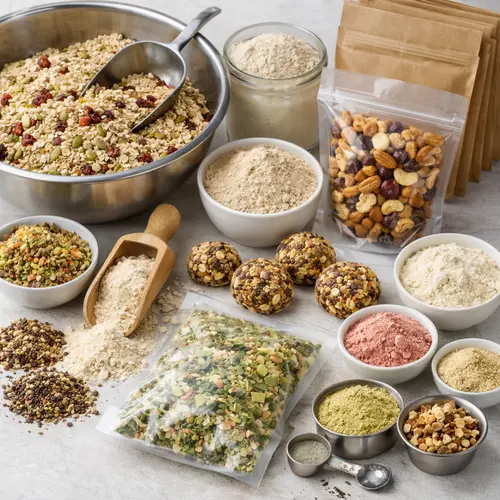
What “custom blends” can mean
Every product line has different constraints. We support custom work by aligning your formula, specs, and packaging with feasible supply options—while keeping documentation and traceability ready for your QA and receiving teams.
- Dry blending: multiple ingredients blended to a target ratio and homogeneity.
- Custom processing: cut size, sieve range, milling/grinding, de-dusting, or screening.
- Format flexibility: whole, flakes, granules, powder—depending on ingredient behavior.
- Packaging & labeling: bulk formats and (where feasible) private label/co-pack support.
Who this is for
If you manage a manufacturing line or a brand with co-packers, custom formats can reduce handling steps, improve consistency, and help protect your quality targets across production runs.
- Manufacturers: bakeries, cereal/granola, snacks, nutrition, beverage mixes.
- Brands & co-packers: pre-mixes, seasoning-style dry blends, inclusion packs.
- Foodservice: standardized blends for multiple locations or contract production.
- R&D teams: short-run pilots leading into recurring procurement.
Common formats
Below are typical processing and presentation formats. Availability varies by ingredient type.
- Whole / rolled / flaked (as applicable)
- Sliced / diced / chips
- Granules / meal
- Powder / fine powder (mesh targets available)
- Sieve-controlled fractions (e.g., “through” and “on” ranges)
Need a specific cut size, sieve range, or moisture spec? Share your application (e.g., bar inclusion vs. beverage mix) and we’ll match an option.
Options & documentation
Support varies by origin and format—request current details with your quote.
- Documentation: COA, spec sheets, allergen statements, lot traceability
- Certifications (where available): organic, kosher, non-GMO programs
- Food safety: supplier verification support and standard receiving documentation
- Logistics: pallet configuration guidance, lead time estimates, delivery region planning
- Import/export: assistance with paperwork when applicable
Blend & processing capabilities (typical requests)
These are common needs we see from USA & Canada buyers. You can use this list as a checklist for your request.
| Capability | What it solves | What we need from you |
|---|---|---|
| Dry blending to ratio | Consistent flavor/texture, fewer line-side steps, reduced operator variability. | Formula ratios (by %), target batch size, and tolerance for natural variability. |
| Particle size alignment | Even distribution, reduced segregation, better visual and bite consistency. | Target sieve/mesh range, acceptable fines %, and end-use (e.g., bars vs. drinks). |
| Milling / grinding | Improved solubility, faster hydration, and smoother mouthfeel. | Target granulation (e.g., “fine powder”), moisture limits, and flavor sensitivity. |
| Screening / de-dusting | Reduced dust, improved flowability, cleaner packaging operations. | Dust tolerance, preferred “through/on” specification, packaging method. |
| Allergen-aware handling | Helps align with your allergen management program and receiving requirements. | Your allergen list, “free-from” claims (if any), and label statement requirements. |
| Packaging formats | Optimized receiving/storage; bulk for production, smaller for foodservice. | Preferred net weight, liner type, pallet height limits, warehouse constraints. |
| Private label (when feasible) | Brand-ready distribution and simplified co-packer coordination. | Label artwork, compliance notes (USA/Canada), case pack, and forecast volume. |
Capabilities depend on ingredient behavior (oil content, hygroscopicity, brittleness), required controls, and volume. Share your requirements and we’ll propose a realistic approach.
How requests typically work
To move quickly, we aim to confirm feasibility, documentation, and lead times early—then align on pricing and logistics.
- Define the target: end-use, format, and any label/certification needs (organic/kosher).
- Confirm ingredients/specs: particle size, moisture, and any “free-from” requirements.
- Quote & lead time: MOQ, price bands (by volume), packaging options, and delivery region.
- Approval & production: sample or pilot (if needed), then recurring lots with lot-level documentation.
Common pitfalls (and how to avoid them)
- Unspecified particle size: blends can segregate if ingredient sizes are mismatched.
- Missing allergen expectations: call out allergens early to align handling and labeling.
- Ambiguous “organic” needs: confirm if every component must be organic or only select ones.
- Packaging assumptions: confirm case pack, pallet requirements, and warehouse constraints.
- Lead time surprises: seasonal items or special milling can extend lead times.
If you’re unsure, send your product label draft or a brief product description—we’ll help translate it into a workable spec.
Example use cases (inspiration)
Below are illustrative examples of what buyers often request. These are not finished product formulations—just common categories that help communicate intent.
Oat-based blends
- Granola base blends (oats + seeds + inclusions)
- Instant oat blends (fine cut + functional add-ins)
- High-fiber breakfast mixes (oats + brans + powders)
- Protein-friendly dry mixes (oats + plant proteins)
Best when particle sizes are aligned to reduce separation during shipping and handling.
Functional premixes
- Texture and binding premixes for bars
- Beverage dry mixes (flow + dispersion focus)
- Baking premixes (consistency across plants)
- “Base + add later” modular blends
Often requires tighter moisture/flow controls and clear mixing instructions.
Inclusions & toppings
- Fruit/nut inclusion packs (size-controlled)
- Crunch components (chips, crisps, granules)
- Bakery toppings (uniform look & coverage)
- Snack mixes (color/texture consistency)
Sieve selection and brittleness management can reduce fines generation in transit.
Spec builder (copy/paste)
Use this as a quick template in your email or quote form. The more detail you provide, the fewer back-and-forth questions.
Product / Blend name:
Ingredients & ratios (if known):
Format: whole / flakes / diced / granules / powder
Target particle size / sieve range:
Moisture target (if required):
Certifications: organic / kosher / other
Allergens to declare / avoid:
Packaging: bulk bag weight, case pack, pallet notes
Annual volume estimate:
Delivery region: USA / Canada (state/province)
Target timeline: sample, first order date, recurring schedule
If you can’t share ratios, we can still help by quoting components and processing options—but a ratio helps us estimate blending feasibility and pricing.
Quality, traceability & receiving
Many buyers need predictable paperwork for receiving and audits. While availability differs by supplier/origin, these are common items we can support.
- COA: lot-level testing summary (as available)
- Specification sheet: key parameters used for procurement and receiving
- Allergen statement: to support your labeling and program requirements
- Traceability: lot IDs and basic chain-of-custody for planning
- Country of origin: documentation support when needed
Related categories
Browse categories where these capabilities are commonly requested:
Oats Nuts & Seeds Plant Proteins Dried Fruit Freeze Dried
If some category links above don’t exist on your site yet, remove them or point them to your correct category URLs.
Request a quote for Custom blends & more options
Share target specs (organic/kosher), format, allergen needs, annual volume estimate, and delivery region (USA/Canada). If you’re moving fast, include your desired ship date and any required documentation.
We support manufacturers, brands, and co-packers. For best results, provide a receiving address region and whether you prefer bulk pallets or smaller case packs.
Prefer email? Send your spec to contact@atlastradehouse.com.
FAQ
Do you have minimum order quantities (MOQs)?
MOQs depend on the ingredient, format, and whether blending/processing is required. Share your target volume and we’ll confirm the best-fit MOQ options (and whether a pilot run is available).
Can I request organic and conventional pricing?
Yes. Where available, we can quote organic and conventional options so you can compare cost, labeling, and lead times.
Do you offer custom blends?
Yes—custom dry blends and processing formats are available depending on ingredients, specs, and volume. We can align on particle size, homogeneity expectations, allergen considerations, and packaging.
What documentation can you provide?
Common documentation includes COAs, specification sheets, allergen statements, lot traceability, and supporting export/import documents when applicable. Availability can vary by origin and format—request current details with your quote.
What information helps you quote fastest?
Ingredient list (or category), target format/particle size, certification needs, allergens, annual volume estimate, preferred packaging, and delivery region (USA/Canada). If you have a spec sheet, send it—otherwise describe the application and we’ll propose a starting spec.
If your QA team has specific requirements (e.g., vendor approval forms, audit questionnaires, or additional statements), attach them to your request so we can respond efficiently.