Wholesale ingredient • Documentation support • Custom processing
Coconut Oil
Wholesale supply for Coconut Oil with consistent specs, food safety documentation, and flexible bulk packaging for manufacturers and brands in the USA & Canada.
For faster quoting, include: grade (virgin/refined), required certifications, packaging (pails/drums/totes), and ship-to region.
Overview
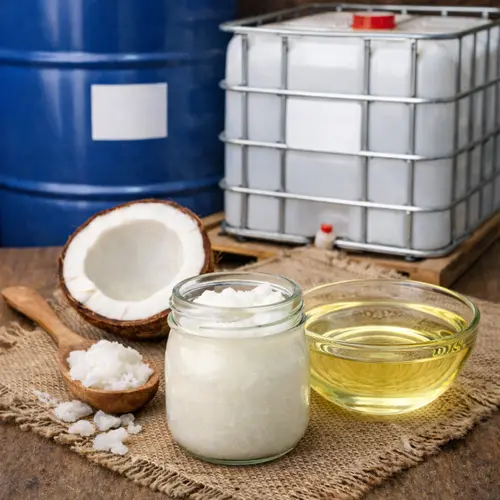
Coconut oil is a versatile edible oil used across food manufacturing, confectionery, bakery, snacks, and nutrition products. It’s valued for its fat functionality, texture contribution, and label familiarity. Depending on the grade, coconut oil can be selected for coconut-forward aroma/flavor (virgin) or for neutral taste/odor and consistent industrial processing (refined/deodorized).
- Functionality: improves mouthfeel, texture, and fat-phase structure
- Processing fit: works in blending, mixing, and depositing lines
- Supply programs: bulk packaging for repeat production cycles
- Claims support: organic/kosher options where available
Coconut oil may be solid or semi-solid at cooler ambient temperatures. If your receiving dock is cold, tell us—this impacts unloading and freight planning.
Who this is for
We support buyers who need reliable documentation and procurement-ready packaging formats.
What we can align on
- Grade selection (virgin vs refined) based on sensory and process needs
- Packaging and handling constraints (pails/drums/totes; unloading equipment)
- Documentation checklist for receiving and QA approval
- Repeat program planning with spec windows and continuity
Fast quote checklist
- Grade: Virgin (VCO) or Refined (RBD)
- Certs: Organic / Kosher (if needed)
- Packaging: pails / drums / totes
- Volume: trial + annual forecast
- Ship-to: state/province + zip/postal
Common program needs
- Neutral sensory for chocolate, coatings, bakery
- Coconut aroma for coconut-forward SKUs
- Consistent spec ranges for repeat batches
- Lot traceability and QA documentation
Documentation support
- Specification sheets
- Lot COAs
- Allergen statements
- Origin information
- Certificates where applicable
Grades & types we commonly source
Coconut oil options vary by processing method, sensory profile, and program requirements. Below are the types buyers most frequently request.
Virgin Coconut Oil (VCO)
Often chosen when the finished product benefits from a coconut aroma/flavor or a “virgin” positioning. Buyers commonly use VCO in premium snack items, coconut-forward confections, certain bakery items, and specialty products.
- Sensory: typically more coconut aroma/flavor
- Use case: coconut-forward taste profiles
- Positioning: “virgin” labeling strategy (buyer-specific)
Refined Coconut Oil (RBD)
Refined, bleached, and deodorized (RBD) coconut oil is frequently requested for neutral odor/taste and consistent industrial performance. Common for confectionery, bakery, coatings, and applications where flavor impact must be minimal.
- Sensory: more neutral
- Use case: neutral fat phase for broad formulations
- Processing: aligned to consistent manufacturing runs
Expeller-pressed / deodorized options
Depending on availability and program needs, we can discuss processing selections that align with your purchasing and QA requirements.
- Deodorized options for reduced aroma
- Options aligned to specific customer spec windows
- Program continuity planning for repeat lots
Organic & kosher options
Where available, we can quote organic and/or kosher coconut oil options. If you require specific certificate types or documentation formats, include that in your quote request so your QA team can approve efficiently.
- Organic: program availability varies
- Kosher: confirm current status per offered lot
- Docs: certificate copies available where applicable
Choosing the right grade
Choose Virgin when:
- You want noticeable coconut aroma/flavor
- Your product is “coconut-forward” (taste profile)
- Premium positioning is important to your customer
Choose Refined (RBD) when:
- You want a neutral taste/odor
- Your recipe is flavor-sensitive (chocolate, coatings, delicate bakery)
- You need consistent industrial processing behavior
If you share your finished product category and whether coconut aroma is acceptable, we can recommend the most practical option to quote.
Packaging & handling (bulk programs)
Packaging options depend on supplier and lane. We’ll confirm available net weights and best-fit formats for your receiving capabilities.
Typical packaging options
- Pails: useful for R&D, trial runs, and smaller programs
- Drums: common for manufacturing-scale purchasing
- Totes / IBCs: large volume programs and frequent usage
Tell us if you have a drum handler, forklift, or tote pump setup—this helps us recommend the right packaging.
Receiving considerations
- Temperature: coconut oil can solidify in cooler environments
- Unloading: plan around dock temperature and equipment
- Scheduling: align delivery windows to avoid re-delivery fees
- Sampling: note if you need receiving samples or retains
If your facility requires heated freight or temperature restrictions, mention it up front.
Storage & handling best practices (practical checklist)
- Store sealed containers in clean, dry areas away from strong odors
- Use FIFO inventory rotation and track lot codes
- Minimize repeated heating/cooling cycles where possible
- Confirm pump/gasket compatibility for edible oils
For winter lanes, include your dock conditions (heated/unheated) so we can propose the most practical freight approach.
- Consider receiving windows that reduce exposure to cold
- Validate handling procedures if the oil is semi-solid on arrival
- Coordinate with your QA team on sampling timing
Typical specification parameters (buyer checklist)
Specs vary by grade and origin. Below is a non-exhaustive checklist of parameters buyers commonly align on. We’ll provide the actual spec sheet and COA for the offered lot.
| Parameter | Why it matters | What buyers commonly specify |
|---|---|---|
| Appearance / color | Impacts finished product look and coating consistency. | Color range acceptance; clarity when melted. |
| Odor / taste | Determines suitability for neutral applications. | Virgin aroma allowed vs deodorized requirement. |
| Free fatty acids (FFA) | Quality indicator that can affect stability and taste. | Max FFA limit aligned to your QA spec. |
| Peroxide value (PV) | Oxidation indicator that can drive off-notes. | Max PV for sensitive formulas or long shelf life. |
| Moisture & volatiles | Lower values help reduce hydrolytic rancidity risk. | Target maximum moisture/volatiles. |
| Melting profile | Important for process temperatures and texture behavior. | Acceptance window for production consistency. |
| Allergen statement | Supports labeling and facility controls. | Cross-contact declarations and allergen matrix. |
| Origin & traceability | Important for procurement and customer requirements. | Country of origin + lot traceability fields. |
| Certifications | Needed for claim support and certain customers. | Organic/kosher certificates where applicable. |
What to send if you have an internal spec
- Grade (VCO vs RBD)
- Max FFA / PV acceptance criteria
- Sensory requirements (neutral vs coconut aroma)
- Documentation checklist (COA/spec/allergen/certificates)
- Packaging, net weight, and delivery constraints
If you don’t have a spec yet
No problem—tell us your end use and constraints and we’ll propose practical options.
- Finished product category (bakery, confectionery, snack, sauce, etc.)
- Does coconut aroma/flavor matter?
- Process temperatures and storage conditions
- Trial quantity + annual forecast
Applications
Coconut oil is used across a wide range of formulations. Below are examples to help you pick the right grade for your use-case.
Bakery & snack manufacturing
- Fat phase for dough, fillings, icings, and baked snack systems
- Texture contribution (bite, softness, mouthfeel)
- Carrier for flavors and fat-soluble ingredients
If you need minimal flavor impact, refined/deodorized coconut oil is often selected.
Confectionery, coatings & inclusions
- Used in fat-based coatings and confectionery structures
- Supports mouthfeel and melt behavior in certain systems
- Helps manage texture in inclusions and fillings
Share your finished product sensitivity to aroma and your processing temperatures.
Spreads, sauces & prepared foods
- Texture-building and mouthfeel contribution
- Fat phase in emulsified or blended products
- Useful for clean-label fat systems depending on formulation
If you need a fully liquid oil across colder storage, ask about alternatives or complementary solutions.
R&D and scale-up
- Trial packaging for bench-top validation (where available)
- Drum programs for pilot/co-packer runs
- Spec windows aligned for repeat production
Include your target launch date and forecast to support continuity planning.
Quality & documentation support
We support procurement and QA teams with the documentation needed for receiving and vendor approval workflows. Availability depends on the supplier and program, and we’ll confirm what’s available in your quote.
Common documents
- Specification sheet (key parameters and ranges)
- COA per lot (lot-level test results)
- Allergen statement (incl. cross-contact declarations)
- Country of origin and traceability details
- Certificates (organic/kosher where applicable)
Helping your team move faster
- Align must-have spec limits before booking
- Confirm packaging, freight, and receiving constraints early
- Support lot traceability for production planning
- Discuss program continuity for repeat runs
If you have a vendor approval form or questionnaire, attach it with your inquiry so we can streamline the process.
FAQ
Questions we hear often from manufacturers and brand buyers.
Do you have minimum order quantities (MOQs)?
MOQs vary by grade (virgin vs refined), packaging (pails/drums/totes), and availability. Share your target volume and ship-to region and we’ll reply with MOQ and pricing tiers.
Can I request organic and conventional pricing?
Yes. Where available, we can quote organic and conventional options so you can compare cost, lead time, and labeling fit.
What’s the difference between virgin and refined coconut oil?
Virgin coconut oil is commonly selected for coconut aroma/flavor. Refined coconut oil (often deodorized) is typically chosen for a more neutral taste/odor and consistent processing performance in industrial applications.
What documentation can you provide with coconut oil shipments?
Common documentation includes specification sheets, lot COAs, allergen statements, and origin information. Organic and kosher certificates can be provided where applicable and available—confirm current status with your quote request.
How do I request a fast quote?
Share: grade (VCO/RBD), any required certifications, packaging (pails/drums/totes), trial volume and annual forecast, and ship-to region. If you have an internal spec (max FFA/PV, sensory requirements), attach it or paste key parameters.
Do you support private label or custom packaging?
Yes—private label and custom packaging can be discussed for qualified volumes depending on lead time and labeling requirements.
Related categories
Browse categories where this ingredient is commonly sourced:
Request a quote for Coconut Oil
Share target specs (organic/kosher), grade (virgin/refined), packaging, annual volume estimate, and delivery region (USA/Canada). Use the quick builder below to pre-fill details, then click Request Pricing.
Quick quote builder (optional)
What we’ll confirm in our reply
- Available options: virgin/refined grades aligned to your sensory needs
- Packaging: pails/drums/totes and typical net weights for your lane
- Documentation: spec sheet, COA, allergen statement, certificates where applicable
- Lead time: current availability and shipping considerations
- Next steps: sampling, vendor setup, and program scheduling (if needed)
If your QA team requires a vendor packet or questionnaire, attach it to speed up approval.