Home / Products / Freeze-Dried Vegetables & Herbs / Asparagus
Wholesale ingredient • Documentation support • Custom processing
Asparagus
Wholesale supply for Asparagus with consistent specs, food safety documentation, and flexible formats for USA & Canada buyers. Commonly used for soup mixes, meal kits, savory seasoning blends, and ready-to-cook applications that need dependable rehydration performance.
What are asparagus ingredients used for in manufacturing?
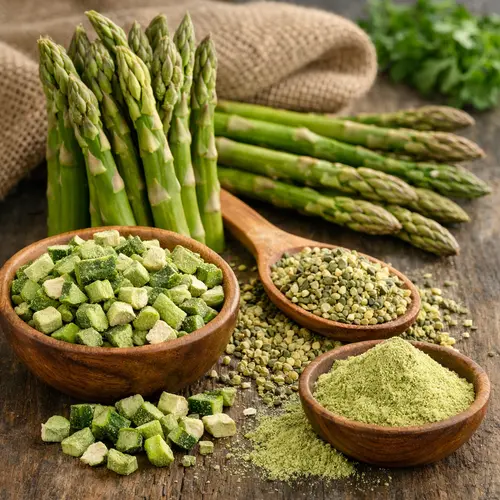
Asparagus ingredients are used when manufacturers want a recognizable vegetable note and a premium “green vegetable” cue in dry mixes and prepared foods. Depending on format, asparagus can provide visible inclusions (pieces), blend-friendly distribution (granules), or background flavor integration (powder).
If your product needs a visible vegetable identity, choose pieces or cuts. If you need consistent distribution and dosing, choose granules. If you need a uniform savory base note, choose powder.
Fast quote checklist
Send these details to get the fastest, most accurate pricing and lead-time guidance:
- Format: pieces/cuts, granules, powder
- Cut size / sieve: target particle size and dust tolerance
- Rehydration target: how quickly it should soften in water/broth
- Certifications: organic, kosher (where available)
- Volume: trial + annual forecast
- Delivery: USA/Canada region + desired timeline
Tip: If you’re blending into a seasoning system, share your blend particle size so we can recommend a cut that mixes evenly.
Request PricingOn this page
Formats & processing
Asparagus can be supplied in multiple formats to match manufacturing requirements. Format choice impacts visual appearance, rehydration speed, distribution in blends, and finished product texture.
Pieces / cuts
- Visible vegetable identity and “real asparagus” cue
- Common for soups, ramen cups, and meal kits
- Cut size can be tailored to rehydration speed
Best when appearance and inclusion texture are key.
Granules
- More uniform distribution than larger pieces
- Useful for dry mixes and seasoning blends
- Can reduce segregation in powder systems
Best for controlled dosing and blend uniformity.
Powder
- Uniform background flavor and easy mixing
- Supports consistent taste across batches
- Defined sieve ranges can improve dispersion
Best when you want asparagus flavor without visible inclusions.
Typical specifications (guidance)
Specifications vary by origin, harvest, and processing format. Below are common spec categories used in procurement and QA. Request current COA/spec targets for the specific option quoted.
| Spec category | What it controls | What to tell us |
|---|---|---|
| Format / particle size | Appearance, distribution, and texture in finished product. | Pieces/granules/powder; target cut size or sieve range; dust tolerance. |
| Rehydration behavior | How quickly pieces soften in broth/water and finished bite/texture. | Your target rehydration time and whether you want firmer vs softer bite. |
| Color appearance | Visual consistency of inclusions across lots. | Whether a greener look is required and how visible inclusions are in final product. |
| Moisture / water activity | Shelf stability, clumping resistance, and storage performance. | Your warehouse conditions and whether the system is moisture-sensitive. |
| Flavor profile | Intensity and background savory character. | Prefer mild vs robust asparagus note; share your usage rate and application. |
| Foreign material controls | Risk reduction for manufacturing and QA programs. | Your internal standards (sieving, metal detection, inspections). |
| Micro targets (as applicable) | Food safety alignment for your category and customer requirements. | Any required micro limits and documentation needs. |
| Certifications | Label claims and customer acceptance. | Organic/kosher needs; any additional claims where available. |
Rehydration & texture considerations
For dehydrated vegetable applications, rehydration time is often the most important performance requirement. The right asparagus cut balances appearance with how quickly it becomes tender in the finished product.
Faster rehydration
- Smaller cuts or granules generally hydrate faster
- Better for “instant” products with short steep times
- Helps avoid firm or under-hydrated pieces
Tell us your steep time and water temperature so we can align a format.
More visible identity
- Larger pieces provide better visual appeal
- Often used in premium soups and meal kits
- May need longer steep or simmer time
If the product has a longer cook step, larger pieces can work well.
Applications & performance notes
Asparagus ingredients are used across soups, meal kits, seasonings, and savory blends. The best format depends on whether you need visible inclusions, fast hydration, or uniform flavor distribution.
Soup mixes
- Pieces for visible vegetable inclusions
- Granules for faster hydration and even distribution
- Powder for background flavor integration
Tell us the typical cook/steep time for best matching.
Ramen & cup meals
- Smaller cuts or granules for short steep times
- Consistent piece size improves consumer experience
- Powder can support seasoning base flavor
Share your “ready time” (3–5 minutes, etc.) and target texture.
Seasoning blends
- Granules for blend uniformity
- Powder for uniform savory note
- Particle size matching reduces segregation
Share your blend particle size and dust constraints.
Ready meals & meal kits
- Pieces for premium appearance
- Granules when distribution matters
- Format selection should match the cook step
Tell us if the consumer simmers, microwaves, or steeps.
Savory bases & custom blends
- Powder for uniform base flavor
- Granules for texture cues in premium blends
- Custom blending may be available depending on volume
If you need a custom blend, share your formula and forecast.
Packaging, storage & shelf life
Dehydrated vegetable ingredients can be sensitive to humidity. Proper packaging and storage help maintain flow, reduce clumping, and preserve product performance.
Packaging options (typical)
- Food-grade bags in corrugated cartons
- Bulk cases with inner liners (format-dependent)
- Palletized shipments for manufacturing
- Private label support (program-dependent)
Tell us your preferred case weight and receiving constraints.
Storage best practices
- Store sealed, cool, and dry; avoid temperature swings
- Reseal quickly after opening to limit humidity exposure
- Use FIFO rotation with lot tracking
- Keep away from strong odors
If you operate in humid climates, ask about packaging upgrades for moisture protection.
Quality, documentation & compliance
We support procurement and QA teams with documentation aligned to manufacturing requirements. Documentation availability can vary by origin and format—request the current set with your quote.
Documentation support
- Certificate of Analysis (COA)
- Specification sheet
- Allergen statement
- Lot / traceability information
- Country of origin information
Certification options
- Organic options (where available)
- Kosher options (where available)
- Other claim support depending on program
Ask what’s available for your preferred format and target volumes.
Spec alignment
- Custom cuts and sieve ranges (program-dependent)
- Moisture targets and flow expectations
- Visual standards for inclusions
- Packaging and pallet configuration support
Share your internal spec or a recent COA to speed up matching.
Learn more about our approach on the Quality & Certifications page.
Logistics for USA & Canada
We support buyers across the United States and Canada with wholesale-friendly packaging and documentation support. Lead times vary based on format, certification, and supply conditions—share your timeline so we can recommend the best fit.
For manufacturers & co-packers
- Specs designed for production planning
- Lot-level documentation for QA release
- Support for forecasting and repeat orders
- Options for custom processing at volume
Import / export support (as needed)
- Documentation coordination to support receiving requirements
- Guidance on what info can be provided by origin/format
- Responsive communication for time-sensitive shipments
If you require special paperwork, include it in your quote request.
FAQ
Do you have minimum order quantities (MOQs)?
MOQs depend on the ingredient and format. Share your preferred format (pieces/granules/powder), target volume, and delivery region (USA/Canada), and we’ll reply with options.
Can I request organic and conventional pricing?
Yes. Where available, we can quote organic and conventional options so you can compare cost, labeling, and lead-time expectations.
Which asparagus format is best for short steep-time products?
Granules or smaller cuts are typically preferred for short steep-time products because they hydrate faster. Share your steep time and water temperature and we can recommend a cut size.
Can you help me choose a cut size?
Yes. Tell us your application (cup soup, ramen, seasoning blend), your target rehydration time, and the finished texture you want. We can recommend a cut size or sieve range that performs well in your process.
Do you provide samples?
Sampling may be available depending on format and program. Include your company name, application, and target specs in your request.
What documents can you provide for asparagus?
Documentation may include COA, specification sheet, allergen statement, country of origin details, and lot/traceability information. Availability can vary by origin and processing format.
Have a question not listed here? Use the contact form and select “Asparagus” to route your request.
Related categories
Browse categories where this ingredient is commonly sourced:
Request a quote for Asparagus
Share target specs (organic/kosher), format, annual volume estimate, and delivery region (USA/Canada). If you have a spec sheet, paste key values (cut size/sieve, rehydration target, and any QA requirements) to speed up matching.
What to include
- Format: pieces/cuts, granules, powder
- Cut size / sieve: target particle size and dust tolerance
- Rehydration target: steep/cook time and desired texture
- Certifications: organic, kosher (if required)
- Volume: trial + annual forecast
- Destination: USA/Canada region and timeline
Need help picking a format?
If you’re unsure, tell us your product type and top priorities: fast hydration, visible inclusions, blend uniformity, or uniform flavor base. We’ll recommend a starting point and provide pricing options where available.
Request PricingYou can also contact us directly at contact@atlastradehouse.com.
Looking for other vegetables or herbs?
Browse our catalog for organic and specialty ingredients used by manufacturers, brands, and co-packers.